NSF Science and Technology Center for Genome Intelligence Engineering (GENIE)
Creating a Principally New Field of Science, Technology and Medicine: Genome Intelligence
The vision of GENIE is a future where we can engineer the genome as a living, physical, self-learning computational system in order to tackle some of the most critical challenges of the 21st century
What Is Genome Intelligence?
Within every human cell, the genome is organized into a computational and physical 3D Genome Geometry Network (GGN), which maintains cellular transcriptional memory and computes transcriptional decisions, including maintaining the cell’s identity or responding to external stimuli. GGN is a neural network of interacting chromatin domains, serving as the network’s nodes. Shown is a representative example of a portion of the GGN within a single genome imaged by GENIE’s Chromatin Scanning Transmission Electron Tomography (each node is shown as a sphere representing the size of the domain and color-coded based on the domain’s density). The banner video at the top of the page shows an enlarged image of a single chromatin domain.
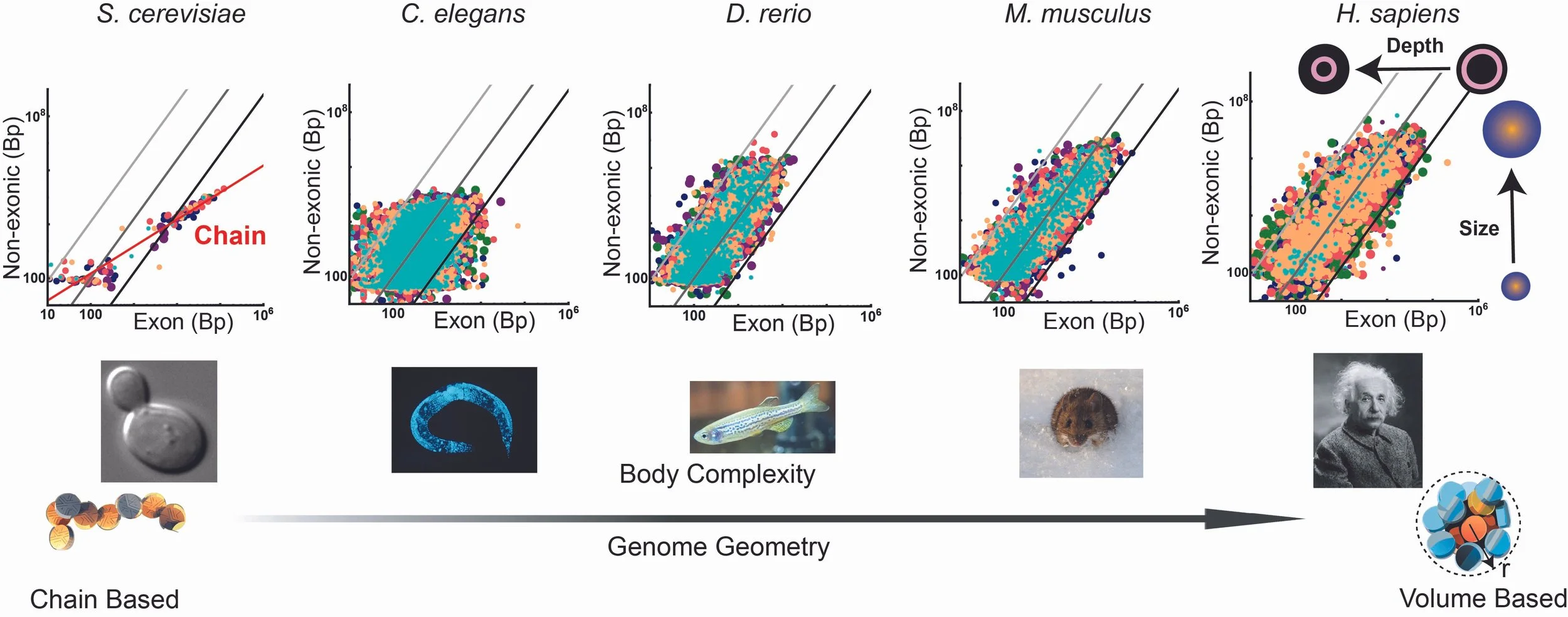
Genome geometry parallels body plan complexity
Until recently, modern biology has approached how the genome processes and stores cellular behavior as if it were simply a hard drive full of DNA, read by proteins. GENIE proposes that the genomes of complex species such as humans are something far more incredible – a dynamic, three-dimensional network that operates as a physical computer, using structural physics and energy to constantly calculate how a cell should behave and regulating its gene expression accordingly. From these calculations, cells actively write memories and define future behavior into the 3D geometry of the physical genome network. When a cell ages, gets injured, or turns precancerous, its DNA sequence usually has not changed. What has changed is the 3D geometry of its genome network - its memory of how to compute proper behavior run amok.
GENIE is building a completely new field of medicine that seeks to understand how the physical, chemical, and molecular properties of genome geometry create this computational system. From these principles, we are identifying specific electromagnetic fields, developing advanced biomaterials, and creating synthetic genome architecting techniques that will allow us to engineer this physical computing system and reprogram the genome geometry network, potentially unlocking the master key cellular resilience to injury, tissue regeneration, and reversing aging-related decay.